If you live in Switzerland, sooner or later you’ll have to get a certificate that attests your German level. This will likely be necessary for your visa, permit (Ausländerausweis), residence permit C (Niederlassungsbewilligung) or to apply for the swiss passport, as it is a requirement of the Swiss State Secretariat for Migration SEM.
The three most popular exams accepted by Swiss authorities are fide, the Goethe-Zertifikat, and TELC.
Although they all meet the legal requirement, their structures, philosophies, and assessment methods differ radically. In this article, I explain the differences between them to help you choose the exam best suited to your profile.
Quick comparison
| Exam | Main focus | Assessment format | Best for… |
| fide | Everyday situations and life in Switzerland | Practical oral and written communication | Those looking for an exam focused on communication and less on proper grammar |
| Goethe | General and academic standard German (Hochdeutsch) | The 4 traditional skills (Lesen, Hören, Schreiben, Sprechen) | Those who prefer a classic academic format, that is internationally renouned. |
| TELC | Standard vocational German | Structured for the 4 traditional skills, but focused on practical use | Those who want a standardized international exam with a strong practical component |
1. fide (das Sprachennachweis)
fide (Français, Italiano, Deutsch) is a system created specifically in and for Switzerland, with the aim of promoting linguistic integration in a pragmatic way.
How is it structured?
The fide exam is divided into two independent parts:
-
Speaking and understanding (Sprechen und Verstehen): Individual oral test with an examiner (aprox. 40 minutes).
-
Reading and writing (Lesen und Schreiben): Written test (aprox. 60 minutes).
Key features:
-
Based on real-life scenarios: Tasks address typical daily situations in Switzerland—such as speaking with a landlord, filling out a form at the local municipality, responding to a work-related notice, or scheduling a medical appointment.
-
No isolated grammar tests: There are no “fill-in-the-blank with the correct preposition” exercises. The focus is on the ability to communicate.
-
Progressive assessment: You can demonstrate skills at different levels within the same exam (for example, achieving level A2 in speaking and A1 in writing, or vice versa).
- Upper limit: fide exams are available only in A1-A2 and A2-B1 versions. Therefore, if your goal is a higher-level certificate, you’ll need a different exam.
2. Goethe-Zertifikat
The Goethe-Institut is THE global reference in teaching the German language and its certificates are recognized worldwide by universities, companies and governments.
How is it structured?
The exam rigorously assesses the four competencies of the Common European Framework of Reference for Languages (CEFR):
-
Lesen (reading)
-
Hören (listening)
-
Schreiben (writing)
-
Sprechen (speaking)
Main features:
-
Standard German (Hochdeutsch): Evaluates the linguistic correctness of standard German (Swiss German is not accepted).
-
Modular structure: From level B1 onwards, it is possible to complete or repeat each of the 4 modules independently.
-
Grammatical and vocabulary requirements: It values precision, rich vocabulary and clear structuring of ideas.
3. TELC (The European Language Certificates)
TELC is a European examination system widely used in German-speaking countries and frequently offered at language schools and Volkshochschulen in Switzerland.
How is it structured?
The TELC format is similar to the Goethe exam, typically consisting of:
-
Written exam: Reading comprehension, language elements (grammar and vocabulary), listening comprehension, and writing.
-
Oral exam: Usually conducted in pairs, it simulates discussions and collaborative problem-solving.
Key features:
-
Focus on daily and professional use: In addition to the general versions (A1 to C2), there are work-oriented versions (TELC Beruf), namely for the medical or care fields.
-
Highly structured: It follows a very predictable format, which facilitates practice with sample exams (Modellsätze).
Pedagogical preparation tips:
-
Assess your own learning style:
-
If grammar makes you anxious but you are able to communicate in daily routines in Switzerland, the fide exam might be the most accessible and least intimidating option.
-
If you have been studying with structured workbooks, have a solid grasp of grammar rules, and want a certificate that is valid outside Switzerland, Goethe or TELC are safe bets.
-
-
Check your canton’s requirements:
-
Although federal SEM rules define minimum levels (e.g., A2 oral / A1 written for a C permit; B1 oral / A2 written for the nationality), always confirm the specific requirements and deadlines set by your municipality or canton.
-
-
Practice with sample exams:
-
Half the battle in a language exam is knowing its structure. Complete several practice tests for your chosen exam to better manage your time and avoid surprises on test day:
- fide: You can find some sample exams on the official website. There are also online preparation platforms (such as FIDE Prep) that appear well-structured, although I am not very familiar with them. Preparing for this exam essentially involves reviewing vocabulary and key phrases, given its highly practical nature.
- Goethe: You can find some sample exams on the official website. Additionally, most testing centers offer preparation courses.
- TELC: You can find some sample exams on the official website. As with Goethe, many testing centers organize preparation courses and there are good preparation books in most libraries.
-
My perspective as a teacher: Which one should you choose?
Although all the exams are recognized by Swiss authorities, the choice largely depends on how you handle language assessment:
- Goethe: In my opinion, Goethe exams aren’t necessarily harder in terms of content, but the grading process is particularly rigorous and demanding. For this reason, if you choose this certificate, I highly recommend taking a preparation course focused on exam techniques. I personally only recommend the Goethe exams for advanced learners, who wish to attest their proficiency with a globally renowned credential.
- TELC: As a TELC examiner myself, I may not be entirely impartial, but this is the exam I most often recommend to my students. It successfully balances a structured, internationally recognized format with a very practical and fair approach to assessment.
- fide: It is the ideal option if your sole objective is to meet legal requirements in Switzerland and you prefer an assessment focused entirely on everyday situations, without the pressure of traditional grammar tests. I recommend this exam for people who learned German “by ear” outside of a formal school setting.
Final recommendations and independent study
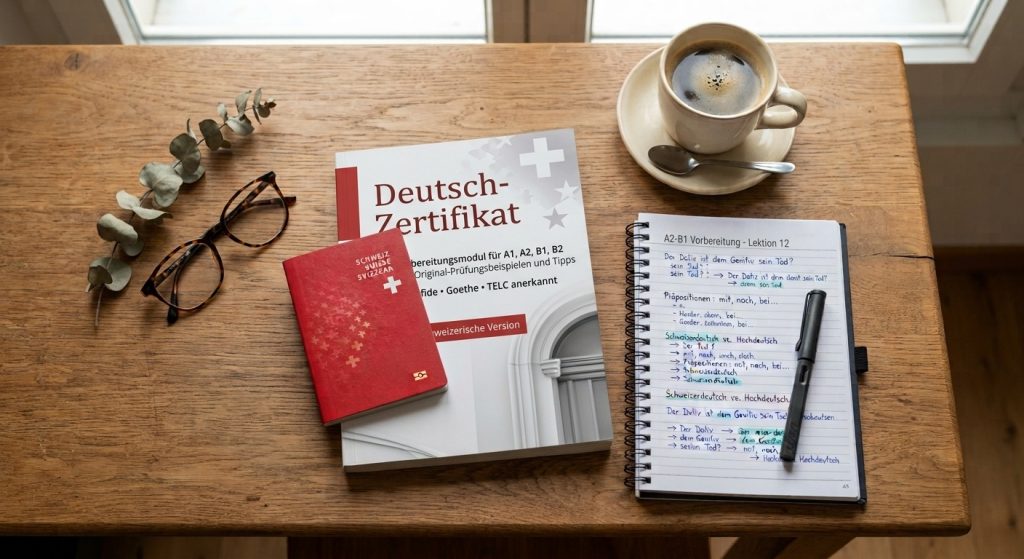
If you are considering taking one of these exams but cannot attend a preparatory course, you can study at your own pace using the right materials. There are preparation books specifically designed for home study (featuring practice exams, explanations, and answer keys).
I have been selecting and adding some of these recommended books to my bookshelf.
If you have questions about the best option for your level or need personalized guidance for your preparation, feel free to get in touch or leave a comment!


