Decoding Your Lohnabrechnung: What Those Swiss Pay Slip Deductions Actually Mean
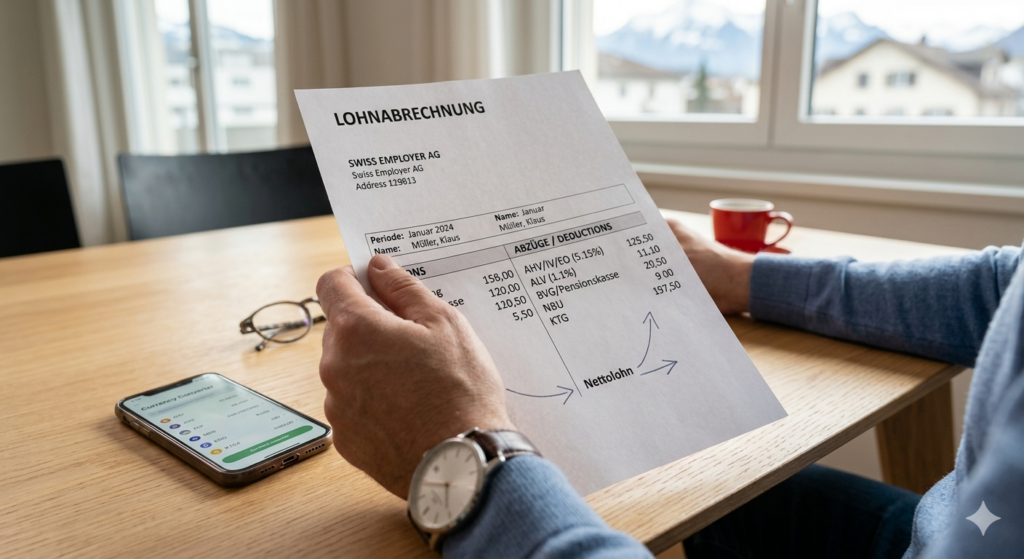
There is nothing quite like the excitement of receiving your first salary in Switzerland. But when you open your official monthly statement—the Lohnabrechnung—you might notice a big gap between your gross salary (Bruttolohn) and the actual amount that lands in your bank account (Nettolohn).
If you look down the page, you’ll see a list of cryptic German acronyms and percentage deductions. Where exactly is that money going?
The Swiss payroll system is incredibly logical once you know the vocabulary. Let’s look at the most common deductions, broken down by category, so you can track every single franc.
The Legal Mandatory Deductions (Gesetzliche Abzüge)
No matter where you work in Switzerland, you will almost certainly see these core acronyms listed near the top of your deductions column.
1. AHV / IV / EO — The First Pillar (5.15%)
This is the heavy hitter on your slip, usually bundled together as one single line item.
-
What it stands for: Alters- und Hinterlassenenversicherung (Retirement), Invalidenversicherung (Disability), and Erwerbsersatzordnung (Income compensation, which covers things like military service and parental leave).
-
Where it goes: This is your mandatory contribution to the Swiss state social security fund. Your employer matches this exact amount, and the money goes to secure basic retirement and disability pensions.
-
The Rate: 5.15% is deducted straight from your gross income.
2. ALV — Unemployment Insurance (1.1%)
-
What it stands for: Arbeitslosenversicherung.
-
Where it goes: This funds the Swiss unemployment system. If you ever lose your job, this insurance ensures you can receive a significant portion of your income while you look for a new role.
-
The Rate: 1.1% of your monthly salary.
3. NBU — Non-Occupational Accident Insurance
-
What it stands for: Nichtberufsunfallversicherung.
-
Where it goes: In Switzerland, your workplace automatically covers you for accidents on the job. But if you work more than 8 hours a week, you are also mandatory-insured through your employer for accidents outside of work—like falling off your bicycle or tripping while hiking.
-
The Rate: Usually between 1% and 3%, depending on your industry’s risk level and your employer’s contract.
4. BVG / LPP — The Second Pillar
-
What it stands for: Berufliches Vorsorgegesetz. You might see it listed on your slip simply as BVG or Pensionskasse.
-
Where it goes: Unlike the AHV fund (which pays current retirees), this money goes into your own personal corporate retirement pot. Your employer must match or exceed whatever you put in.
-
The Rate: This varies wildly. It scales up as you get older (from 7% when you are young up to 18% later in your career), and depends heavily on your company’s specific benefits plan.
- NB: if you don’t have this deduction, don’t worry just yet! It’s compulsory for employees over 24 years old, with a salary over CHF 22’680/year, employed for more than 3 months. If you’re working part time or short time, you might not meet the requirements.
Tax Deductions (Steuer)
5. Quellensteuer (QSt.) — Tax at Source
If you are a foreign worker in Switzerland holding a B, G or L permit, you won’t fill out a traditional tax return at the end of the year. Instead, your taxes are taken directly out of your paycheck every single month.
-
What it stands for: Quellensteuer (Withholding tax / Tax at source).
-
Where it goes: Straight to the cantonal tax office to cover your federal, cantonal, and municipal income taxes.
-
The Rate: A variable percentage based on how much you earn, your civil status (single, married), and how many children you have.
Specialized Deductions (Industry specific)
Depending on your profession or your company’s benefits, you might see these “extra” lines. If you work in a trade with a Collective Labour Agreement (GAV), these are very common:
-
KTG (Krankentaggeldversicherung): Sickness benefit insurance. If you get sick and can’t work for a long time, this insurance ensures you keep getting paid (usually 80% of your salary) after your employer’s legal obligation ends. Although there’s no national law that enforces this insurance, most companies have it.
- Parifonds / Vollzugskosten: These are contributions to professional funds that help pay for basic and further training in your industry, as well as the costs of monitoring work conditions. If you are a member of a trades union, you can ask for a refund of this contribution.
-
FAR (Frühpensionierung Baugewerbe): Specifically for those in the construction main trade. This is a contribution toward an early retirement fund, allowing construction workers to retire with dignity at age 60. Some other industries have similar funds.
What’s NOT on your pay slip?
Remember: In Switzerland, your Health Insurance (Krankenkasse) is private. You pay this bill yourself every month; it is not deducted from your salary.
Quick Vocabulary Cheat Sheet:
-
Bruttolohn: Gross salary
-
Nettolohn: Net salary (The “take-home” pay)
-
Abzüge: Deductions
-
Beitrag: Contribution
💬 Over to you: What’s on your slip?
Swiss pay slips can be full of surprises! Did you find an acronym on your Lohnabrechnung that I didn’t mention here? Maybe a “Solidaritätsbeitrag” or a specific “Kantine” deduction?
Drop a comment below with the acronym you’re curious about, and let’s figure out where that money is going together!


